Close to the Door
A free app for finding accessible parking, built by a Disabled developer with Disabled people.
- Role
- Founder and sole developer
- When
- 2025 to present
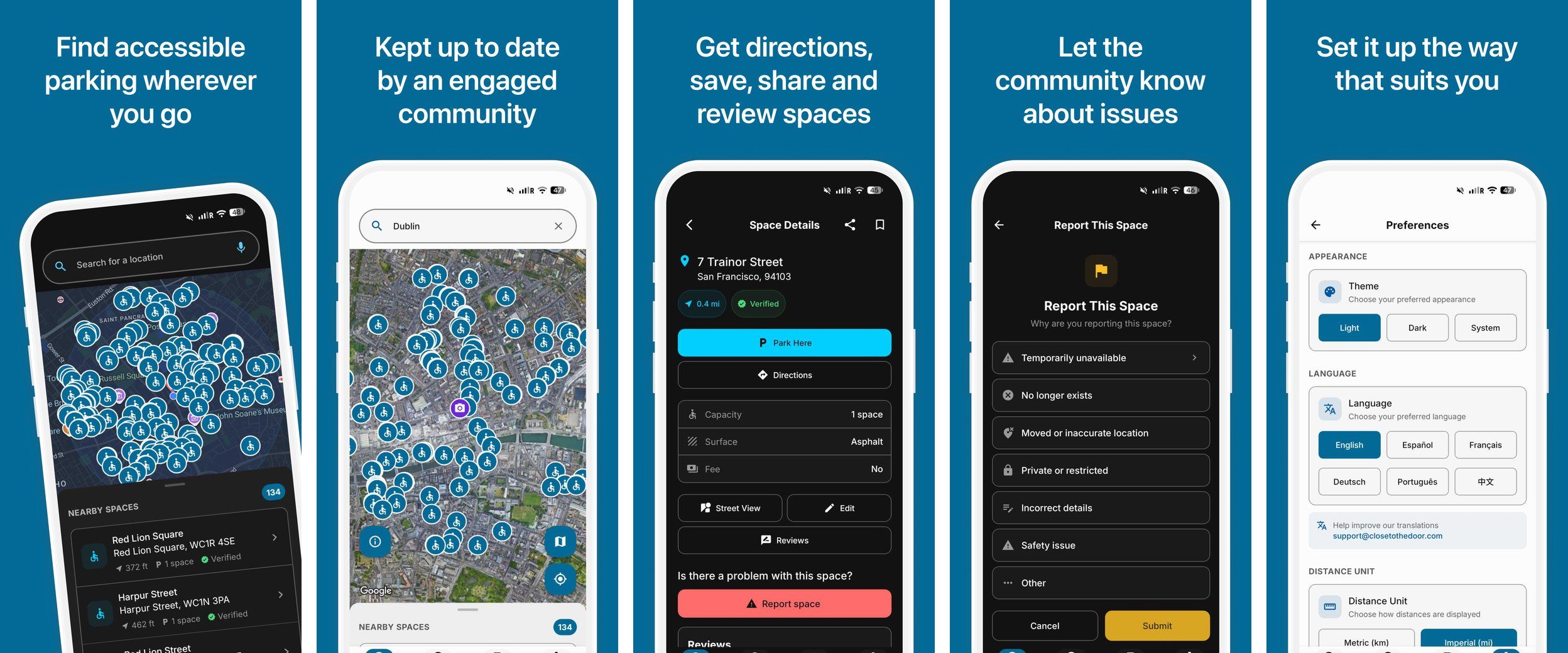
A painted wheelchair symbol tells you very little about whether a parking space will work for you: whether it is wide enough to open your door, whether there is a dropped kerb, whether you can get in and out at the back. Those details decide whether somebody gets to the appointment, the shop or the theatre, and they are the ones you cannot check until you arrive. I am a Disabled driver, and this started as a problem I had myself.
What it does
Close to the Door puts that information in one place and keeps it current through the people who use it. You can find accessible spaces near you, add ones that are missing, and review the ones you have used. You can note the things that matter, such as a dropped kerb, the width or rear access, mark a space as taken, or flag one that is temporarily unavailable because of roadworks.
The map combines four sources: contributions from users, OpenStreetMap, Mapillary street-level imagery, and government open data. It currently holds more than 500,000 locations. The app is free, on iOS and Android, in six languages.
Built with Disabled people
I did not want to take it for granted that the app worked for Disabled people because it worked for me. No two Disabled people are the same, and neither are their access needs. So before launch I asked an accessibility consultancy to run a paid study: twelve Disabled drivers and passengers across the UK, Ireland and Spain, in two phases, on iPhone and Android, with a break between them so that what the first phase found could be fixed and tested again by the same people.
Most of the best decisions in the codebase since then came from those twelve people. A tester who could only get back to the main screen by closing the app gave every screen a way back. Testers who read at roughly 2.4 times the default text size prompted a rebuild of 79 files so that layouts stack rather than clip. Testers who could not get voice search to work, while others called it useful, led to every error being announced out loud instead of failing silently. I wrote the longer version up for other mobile teams; it is in the writing section.
Privacy
Every user has an anonymised username. The app asks for location only to guide you to a space. When you mark a space as taken, other users see that it is occupied and nothing about who by. Personal data is never sold and never used to open doors with councils or businesses.
For councils and businesses
The anonymised feedback goes back to the organisations responsible for the spaces through a portal, so that planning, policy and design can improve where they fall short. For too long the weight of responsibility for access has sat with Disabled people. The portal is one way of moving some of it back.
The engineering
Expo and React Native with TypeScript throughout. Supabase for the database, authentication and edge functions, with every write going through a function that validates, rate-limits and checks the token. A Next.js portal for organisations. Sentry and PostHog for errors and usage, with a watchdog over the scheduled jobs. End-to-end tests through Maestro on both platforms, and a review before every change goes live.